Here's what you'll understand by the end of this: why organizations that have invested heavily in traditional encryption, access controls, and compliance frameworks can still suffer a damaging PII breach and what architectural shift actually closes the gap.
Most data security strategies are built on a reasonable-sounding premise: encrypt the data, control who can access it, and you've protected it.
That premise is incomplete. And that incompleteness is expensive.
The average cost of a data breach has climbed to $4.99 million globally, with financial sector breaches running 28% higher than that. Under India's DPDP Act, penalties reach ₹250 crore. Under GDPR, €20 million. The DPDP Rules also require incident notification to the Data Protection Board within 72 hours, placing intense operational pressure on every organization that handles Personally Identifiable Information (PII).
Yet, despite heavy investments in perimeter defenses and database security, data remains fundamentally vulnerable. The reason isn't that traditional encryption doesn't work. It's that encryption only works in two of the three places data actually lives.
The "Data-in-Use" Vulnerability
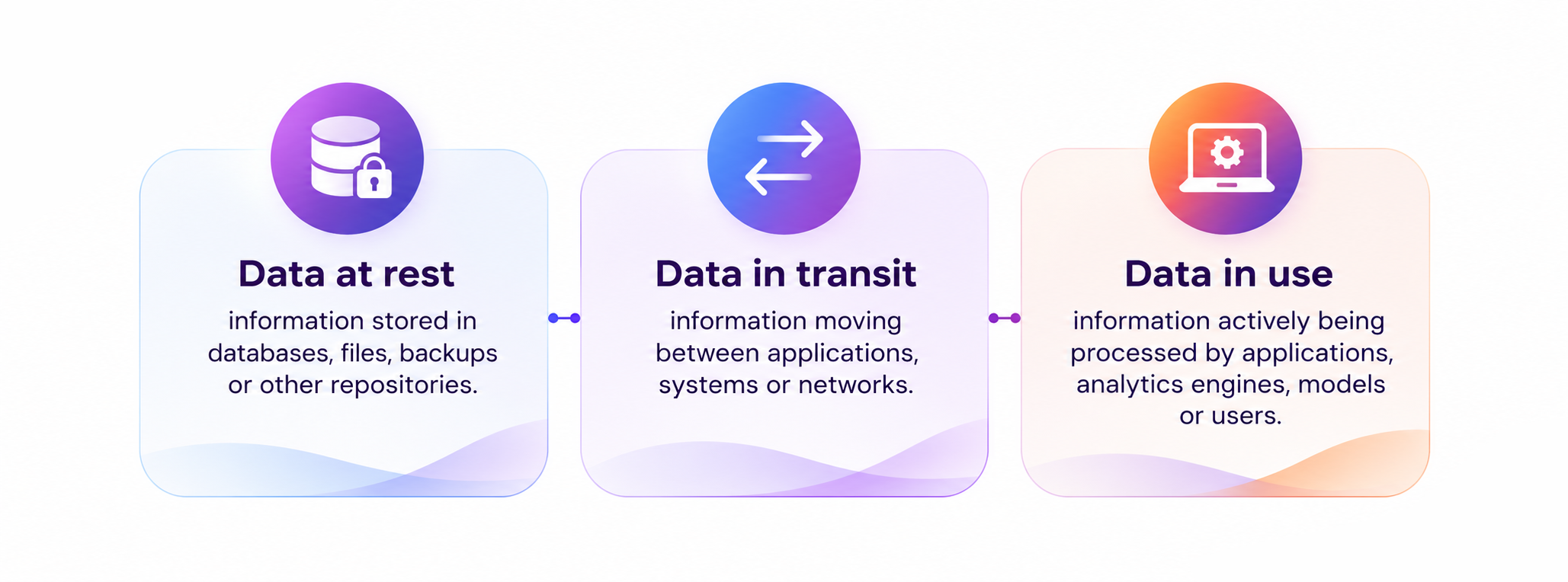
Enterprise data security is structured across three distinct operational layers: data at rest, data in motion (transit), and data in use (processing).
Advanced Encryption Standard (AES-256) handles data at rest well. Transport Layer Security (TLS) handles data in transit well. The security industry has spent decades hardening both of these layers.
Now ask what happens in the third state: when an application needs to use the data?
Customer onboarding, KYC, AML screening, Customer 360, analytics and AI all require data to be processed. Traditional database engines and business applications cannot query, search, or calculate on standard ciphertext. Consequently, sensitive PII must be decrypted back into plaintext in system memory whenever an application needs to process customer data.
This temporary visibility window creates an operational paradox akin to opening a high-security vault every time a single gold bar needs to be counted, exposing raw customer identifiers to memory scraping, insider threats, over-privileged users, and shadow copies.
Encryption Protects Data. Processing Changes the Equation.
The data-in-use vulnerability isn't a flaw in the encryption algorithm. The algorithm is doing exactly what it was built to do. The vulnerability is architectural: the moment data needs to be used, it needs to be decrypted.
During processing, plaintext PII may exist in application memory, databases, temporary files, logs, caches, analytical environments or integrations. The number of people and systems that can potentially encounter decrypted information data can therefore expand beyond the original security boundary.
Think of it as opening a high-security vault every time a single asset inside it needs to be counted. The vault is excellent. The requirement to open it is the problem.
Why the Standard Fixes Don't Fix It
To address this processing gap, enterprises have historically attempted various interim PII security solutions, all of which present severe operational limitations.
- Access Controls: A natural response is to combine encryption with IAM, MFA, RBAC, privileged-access management and monitoring. These controls remain essential. But none inherently change the requirement that an application may need decrypted information to perform its function.
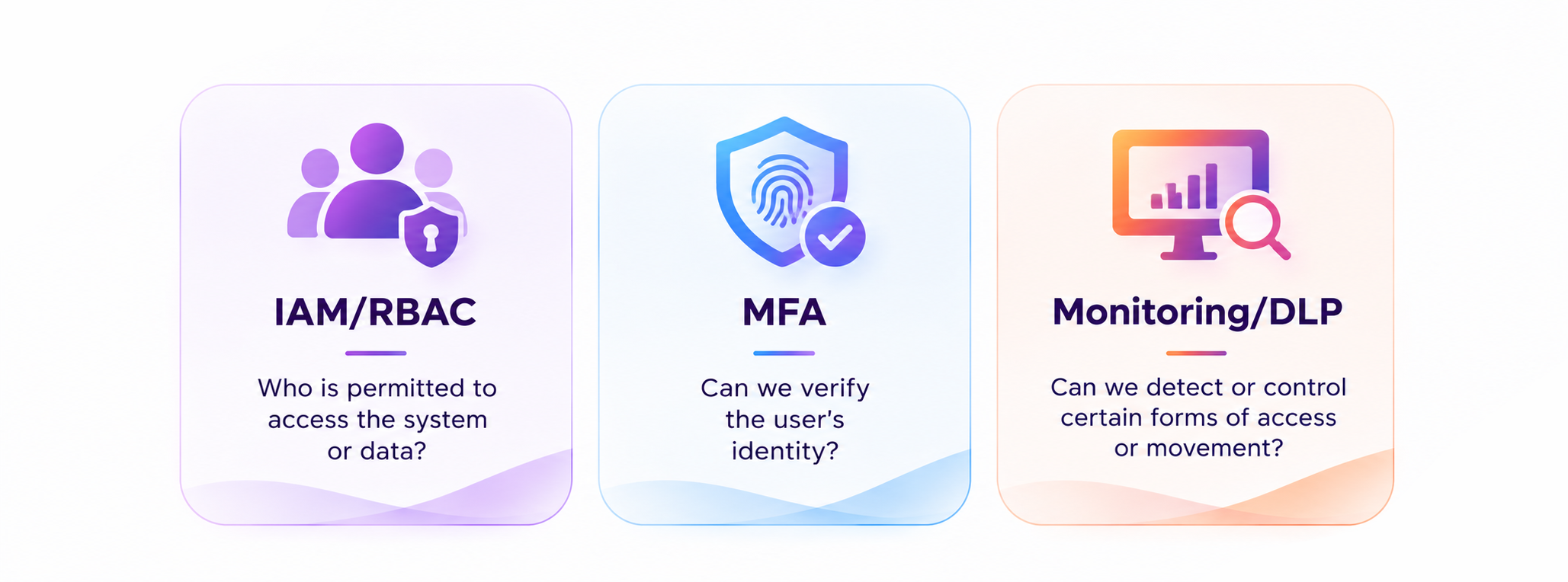
An authorized application or service account can therefore become part of the exposure surface. The risk is not necessarily malicious access. It can be excessive privileges, compromised credentials, vulnerable applications, accidental logging, copying or unintended downstream sharing.
- Key Storage Vaults and TDE: Key management vaults (such as HSMs or HashiCorp) and Transparent Data Encryption (TDE) merely manage encryption keys or protect storage at rest, doing nothing to secure data while it is actively being processed in application memory.
Tokenization and masking can reduce PII exposure, but their usefulness depends on what the application needs to do.
- Masking hides portions of information. For example, displaying only the last four digits of an account number. It is useful when users need visibility without seeing the complete value, but it does not allow operations on the underlying PII. So, while it is altering raw text, it is simultaneously destroying a lot of data utility.
- Tokenization replaces sensitive values with tokens. This can reduce the number of systems handling actual PII, but applications may still require controlled detokenization or specialized token-aware operations for certain workflows.
- Hardware Enclaves: Hardware-based approaches, such as Confidential Computing or Trusted Execution Environments (TEEs), utilize isolated chipsets to secure memory, but they remain prohibitively expensive, introduce hardware vendor lock-in, and are difficult to scale across heterogeneous multi-cloud environments.
Protecting Data While It Is Being Used
Solving the PII security crisis requires a fundamental architectural shift: moving from merely securing storage systems to securing data processing itself. This is achieved through software-based Privacy Enhancing Technologies (PETs).
PETs encompass a family of cryptographic techniques designed to enable useful data processing while keeping the underlying data protected. Depending on the use case, these include homomorphic encryption, secure multiparty computation, federated analytics, differential privacy, and searchable encryption. The objective is not to replace encryption or IAM. It is to extend protection into the one layer where traditional controls stop working: the processing layer.
The practical consequence is significant. When PII is tokenized at the point of ingestion into irreversible cryptographic tokens, and when business operations run on those tokens rather than the underlying values, a breach changes character entirely. An attacker who gains unauthorized access to the database doesn't get customer names, Aadhaar numbers, or account identifiers. They get tokens. Irreversible, unreadable, and useless outside the system that generated them.
The blast radius of a breach collapses.
What This Looks Like in Practice
Posidex's PII Data Vault addresses this data-in-use challenge using searchable encryption and Hashcryption. It enables business applications to process data on fully encrypted datasets with zero plaintext exposure. Unlocking maximum customer data utility while guaranteeing absolute data protection.