Here's what you'll walk away with: a clear understanding of why traditional encryption has a dangerous blind spot, and exactly how Posidex Hashcryption closes it. So you can evaluate whether your organization is actually protected, or just feels like it is.
Most people assume encrypted data is safe data. It isn't. Not always.
There is a near miss that trips up even experienced engineers: AES encryption, TDE, and standard hashing all protect data at rest and in transit. But the moment your system needs to search, match, or process that data, it decrypts it into plaintext first. That window, however brief, is exactly where attackers, insiders, and persistent threats operate.
What Hashcryption Actually Does
Hashcryption is a proprietary, multi-stage privacy technology built to protect Personally Identifiable Information (names, Aadhaar numbers, PANs, phone numbers, dates of birth) while it is being used, not just while it sits still.
Built by Posidex, it does this through the VEARE method: Vectorised, Encoded, Anonymised, Randomized Encryption. Raw sensitive data goes in; a secure, irreversible cryptographic token comes out. The system then operates entirely on those tokens. It allows systems to perform complex operations like searching, matching, deduplicating without ever reverting PII to plaintext.
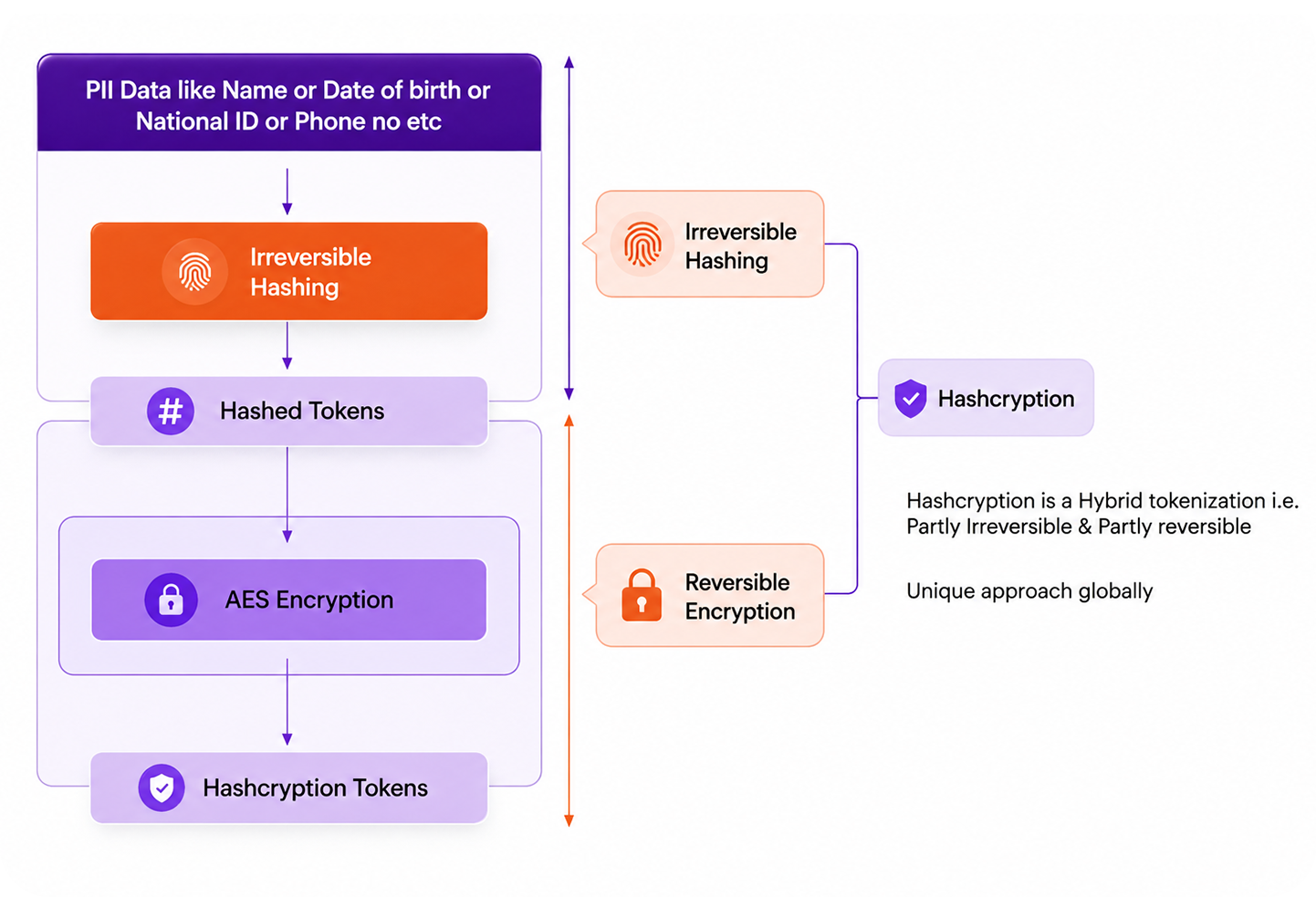
The technology operates in two primary tiers:
- Basic Version: Exact equality searches on encrypted data.
- Advanced Version: Fuzzy search and probabilistic matching (catching typos, phonetic variations, and human error across names and dates) all without exposing the underlying values
The 5-Stage Engine Under the Hood
Hashcryption is a polymorphic hybrid algorithm. It applies a 5-stage pipeline: Vectorization, Encoding, Anonymization, Randomization via a Salt Key, and AES Probabilistic Encryption.
- Randomization at ingestion means the same name entered twice won't produce the same token. That alone defeats pattern-matching attacks that standard hashing is vulnerable to.
- Polymorphic processing means the algorithm doesn't treat a name the same way it treats a phone number or a date. Each data type gets its own tokenization and comparison logic. Because a one-size-fits-all approach to PII is itself a security weakness.
- Partly Irreversible & Partly Reversible: Uses a hybrid approach combining irreversible hashing with reversible randomized encryption. The irreversible layer ensures stolen tokens have no exploitable value. The reversible layer, where needed, keeps legitimate business operations functional.
- In-Memory & Storage Optimization: Stored as persistent object files on disk and loaded into RAM for fast, real-time in-memory processing.
What Makes Posidex Hashcryption Different from Other Encryptions
Ask yourself: what happens to your data between the moment a query is sent and the moment a result is returned? In most systems, it's decrypted. Every query is a window. Every window is an opportunity. Here's how Hashcryption compares on the points that actually matter:
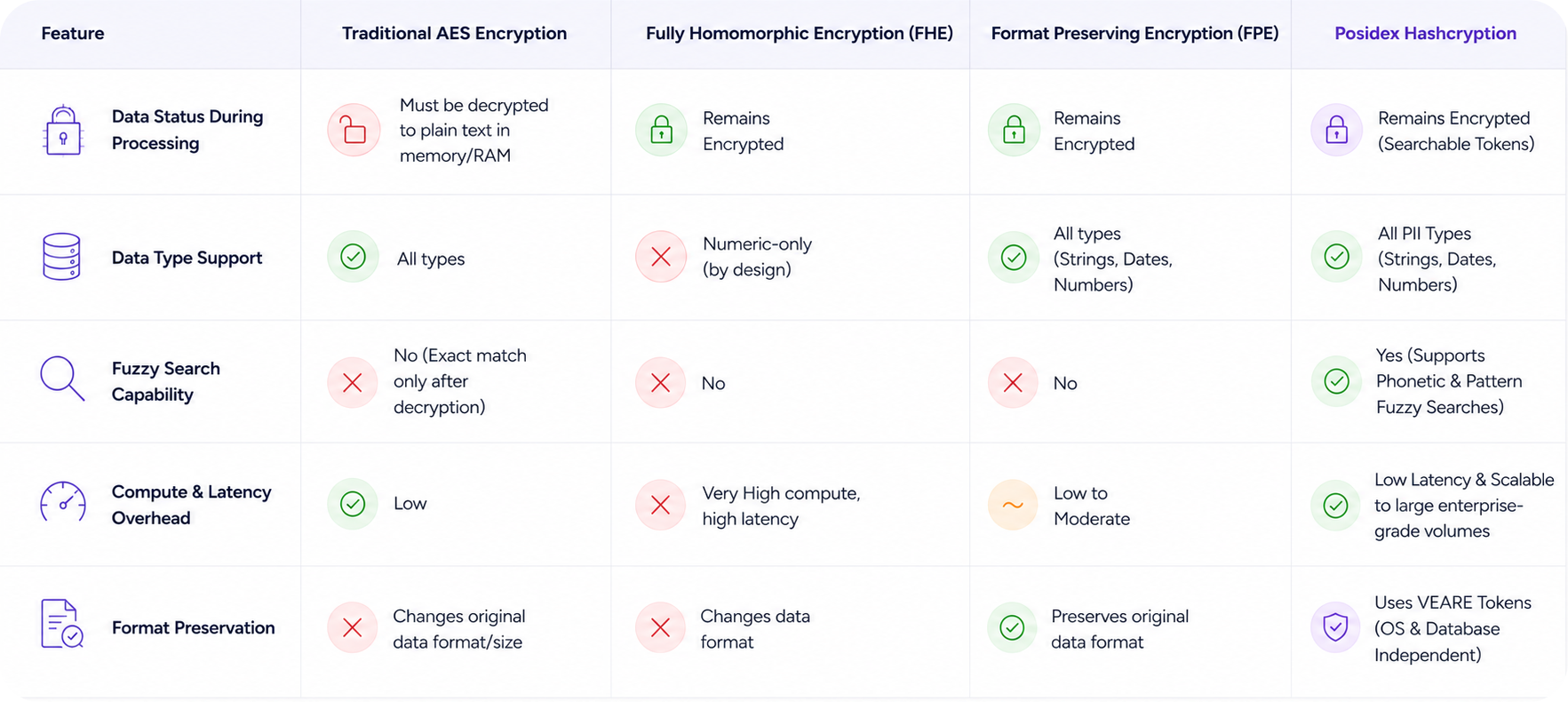
Core Differentiators
- Processing Data-In-Use (Zero Exposure): Traditional encryption methods (such as AES or TDE) protect data at rest and in motion, but decrypt the data into plain text when processing in memory. Hashcryption ensures data remains encrypted even during query and match processing. It ensures zero data exposure while allowing data processing, matching, and queries directly on encrypted values.
- Randomization: Unlike standard hashing, Hashcryption uses salt keys and randomization at the point of ingestion to ensure that the same plaintext value does not always result in the same token, significantly increasing security against pattern-matching attacks.
- Polymorphic Nature: The algorithm uses different tokenization and comparison methods tailored to specific data elements (e.g., different logic for a name versus a telephone number or date of birth).
- Support for Fuzzy Matching: Standard cryptographic hashing (e.g., SHA-256) or standard FHE/FPE algorithms do not support fuzzy logic. Hashcryption uses mathematical equations based on number theory to perform fuzzy searches on encrypted tokens, matching names and dates despite spelling or phonetic variations.
- Production Scalability: Advanced cryptographic methods like FHE often suffer from severe performance latency and high computational costs. Hashcryption is optimized to handle large, population-scale data volumes with millisecond-level response times.
- Infrastructure Independence: It moves processing from the database layer to the application layer, reducing hardware costs and removing dependency on specific database engines.
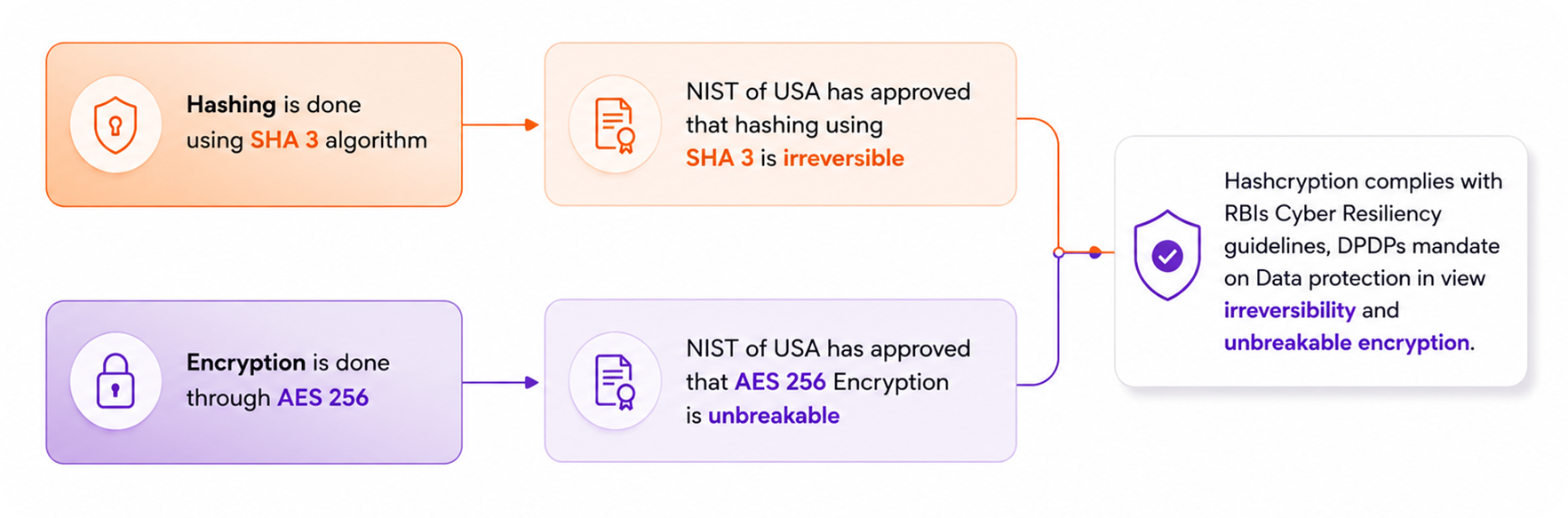
Why Posidex’s Hashcryption Technology Matters Beyond Compliance
- Defending Against Insider Threats
A significant modern risk is where attackers use valid credentials to bypass perimeter defenses. In traditional architectures, if an attacker has a valid login, they can often access decrypted plaintext data. Hashcryption mitigates this because even an authorized user (or an attacker with their credentials) only sees irreversible tokens, not the raw sensitive PII.
- Reducing Data Breach Liability and Cost
The cost of a data breach is often driven by what stolen data unlocks. Each customer or client whose data is stolen faces their own exposure, risk, cost and obligations. This downstream cascade creates an aggregate cost across all affected customers. And that is an even bigger number than just the penalty you face.
- Stolen Data Utility: Unlike traditional ciphertext, which can be unlocked if a key is compromised, stolen Hashcryption tokens are irreversible and have no exploitable value, effectively reducing the blast radius of a breach to zero.
- Liability: While compliance with DPDP Act doesn’t mandate protecting data in use. It should because attackers are not going to wait. Hashcryption potentially reduces legal liability in the event of a breach.
- Addressing Persistent Threats
Some attackers remain undetected in a network for years. If data is only encrypted at rest, it must be decrypted periodically for business use, providing a persistent attacker multiple windows of visibility. Hashcryption eliminates these windows because the data never needs to be decrypted for matching, deduplication, or screening.
- Quantum Safe Technology
There is a growing global mandate to migrate toward post-quantum encryption standards. While traditional mathematical algorithms are vulnerable to future quantum computing, Posidex Hashcryption’s use of proprietary algorithms is a robust defense against the evolving cryptographic threat landscape.
What You Get With Hashcryption
Most encryption protects data when it's sleeping. Hashcryption protects it when it's working. Which is the only time attackers actually care about it.
The question isn't whether your data is encrypted. It's whether it's ever unencrypted when someone with the wrong intentions has access to it.
For most organizations using traditional stacks, the honest answer is: yes, briefly, every single time a query runs.
That's the gap. Hashcryption is built specifically to close it.