What steps you need to take after a data breach depends on 1 decision. A decision that is made long before the breach occurs: “When an attacker reaches your systems, can they actually read the data?”
Consider two organizations, Org A and Org P. Both have strong perimeter security with identity and access controls. Both detect suspicious activity and are eventually breached. Yet what happens next for Org A is very different from Org P.
Customer PII remains one of the most frequently involved categories of compromised data. IBM's Cost of a Data Breach research found customer PII was involved in 53% of breaches.
Org A: Breach Without Protection
On day 1, the security team detects anomalous activity. Forensics begins. Incident response starts and the organization begins determining what was accessed. The clock on mandatory notification has already begun.
Next week, the investigation establishes the scope. The attacker accessed readable personal information: names, identification numbers, account details, transaction histories, health information, credentials or other sensitive records.
Now the organization has a much bigger problem.
Depending on the jurisdiction and the nature of the data, breach notification requirements may apply. Legal teams assess their obligations. Regulators may become involved. Customers may need to be notified. The organization must determine the potential impact and communicate with affected parties. Every affected record adds to the potential cost and complexity of the response.
By the time the month ends, customers and business partners start asking questions. Meanwhile, the team is running several workstreams at once: Forensics. Legal. Regulatory. Communications. Remediation.
The consequences continue long after the vulnerability has been fixed. Regulatory proceedings continue. Customer trust takes years to rebuild.
This is what happens after a data breach for most businesses. It is expensive and disruptive because the attacker did not just reach the system. They exposed PII and that costs!
Org P: Breach With Data In Use Protection
The same attack against Org P, which has implemented data in use protection is very different. On day one, the security team detects anomalous activity. Forensics begins. Investigators determine that an attacker reached systems during active processing.
But sensitive data remained protected. The attacker may have gained access to the system. But the data they encountered was not available as readable plaintext. That’s where the incident ends, instead of stretching for years with compliance, monetary and trust repercussions.
That is the promise of protecting data in use.
Missing layer in PII protection
Org P is achievable.
Data exists across three fundamental states: at rest (stored in databases, file systems, or backups), in transit (moving across network channels), and in use (being actively processed, queried, or analyzed).
Historically, enterprise security standards solved the first two states. However, they require sensitive Personally Identifiable Information (PII) to be decrypted into cleartext whenever an application runs a search, processes a transaction, or updates a record.
This creates a massive decryption window. Attackers do not need to break encryption; they simply wait for running systems to use decrypted data.
Traditional perimeter security controls create a difficult choice for enterprises. Lock sensitive data down so tightly that using it becomes difficult or keep it readily available for business operations and accept more exposure.
Protecting Data in Use
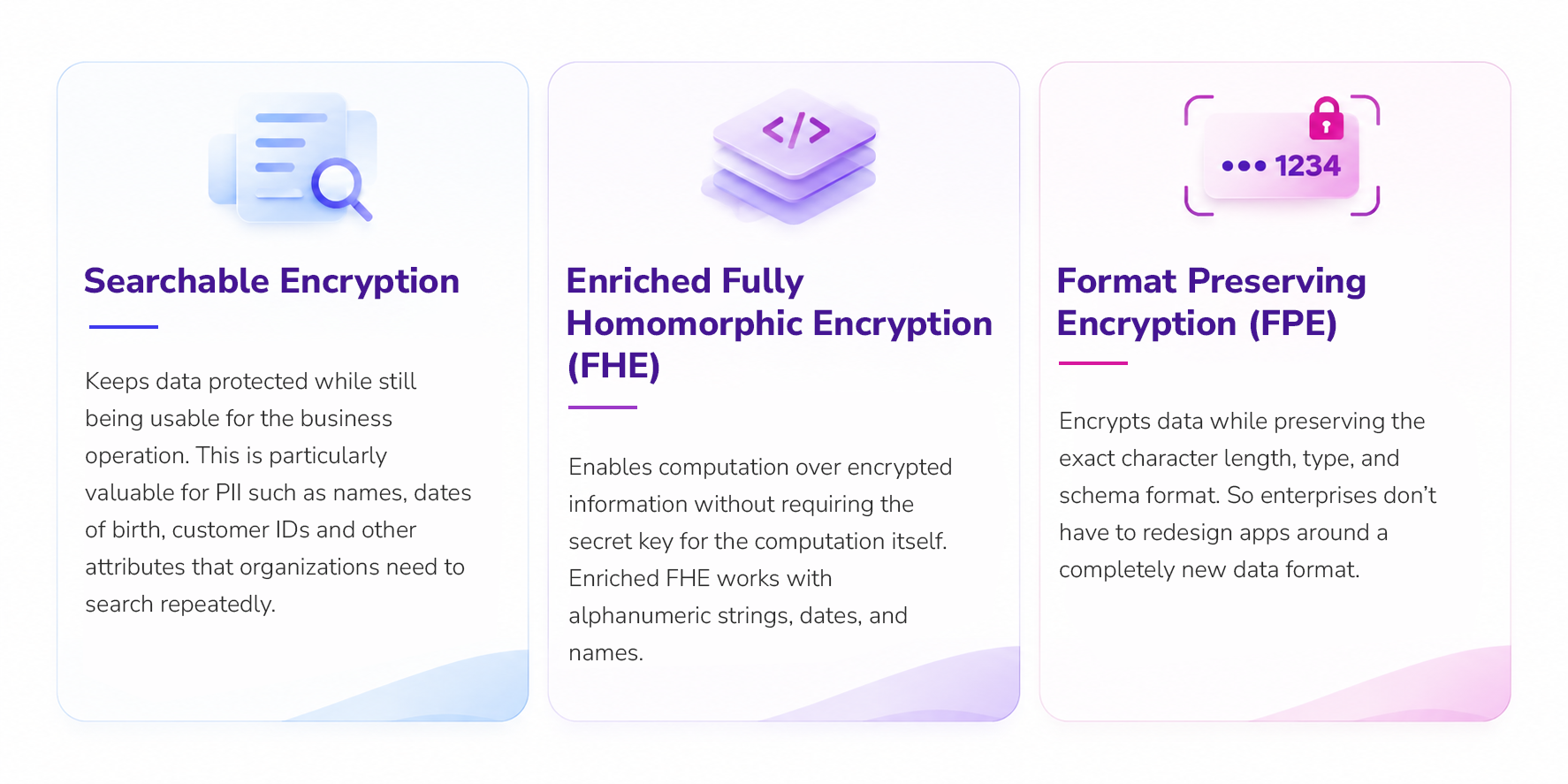
Privacy Enhancing Technologies (PETs) provide data in use security. Instead of treating encryption as something that ends when an application needs to use the data, PET-based architectures extend protection into the processing layer. The protection applied to sensitive data does not disappear simply because the data is being used. Three technologies are particularly relevant.
What PII Data Vault Delivers
PII Data Vault is a secure data processing platform built with quantum-safe Privacy Enhancing Technologies. It keeps PII data in use encrypted. It functions with speed and precision. Businesses that implement it become like Org P, where what happens after a data breach is limited. The attack still occurs but there is no liability cascade.
To understand how PII Data Vault offers data in use protection further, book a call with us.